This Learning Hub article is presented in three parts. Read from the beginning or go directly to any part below.
PART ONE: WHEN A CHILD REPORTS BULLYING
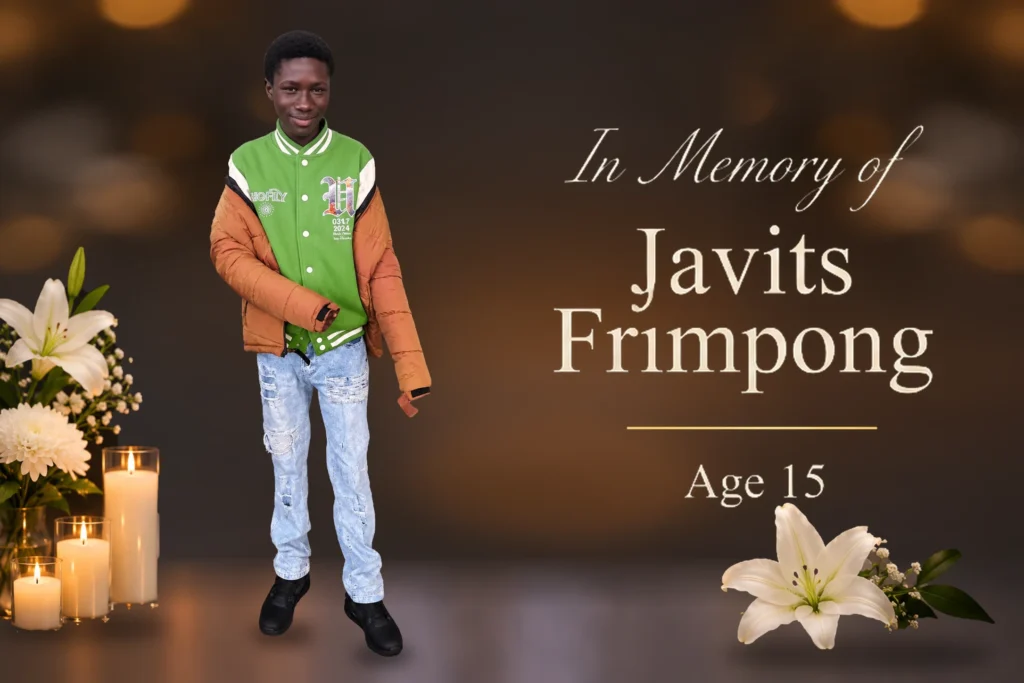
Javits Frimpong was 15 years old.
On the morning of 29th October 2026, he was doing something millions of children do every day.
He was going to school. He never came home.
Javits had moved from Ghana to New York about a year earlier to live with his father. His father, Thomas Frimpong, described him as quiet and clever, and said Javits hoped to become a physician.
He was shot in the abdomen near his school in the Bronx, and he later died.
Police are investigating his killing and have not established a motive. They have also not established that bullying was connected to his death.
That distinction matters. But something else matters too.
His father says Javits had told him he was being bullied at school. An unnamed school bus aide told CBS New York that at least two students had recently been suspended for bullying Javits.
His father relayed words from his son that should make every parent, teacher, school administrator, and adult stop:
“Dad, anytime I am going to lunch, that guy keep on bullying me.”
And then:
“I have been reporting him several times.”
Several times.
We do not know whether the bullying Javits reportedly experienced had anything to do with his killing. We should not pretend that we do.
But according to his father, a 15-year-old boy said that someone was bullying him and that he had reported it repeatedly.
That is enough to ask a question that reaches far beyond one school in New York:
When a child says, “I am being bullied,” what happens next?
That question belongs in schools. It also belongs in homes, marriages, friendships, workplaces, churches, mosques, and every place where one person holds power over another.
Listening Must Lead Somewhere
We often tell children to speak up.
Tell your teacher.
Tell your parents.
Report it.
Don’t keep quiet.
But speaking up is only one half of the responsibility.
The other half belongs to us.
What do adults do after the child speaks?
Do we listen carefully?
Do we find out whether it has happened before and where it happens?
Do we consider what may happen after the report?
Do we check again tomorrow, next week, and the week after?
Or do we tell the child to be strong, ignore it, fight back, or stop being too sensitive?
Reporting bullying may already have required courage. A child should not then carry the additional burden of convincing adults that it matters.
Hearing a report is not the same as creating safety.
Bullying Does Not Always Look Like a Fight
When many of us hear the word bullying, we imagine a bigger child pushing a smaller child in a school corridor.
Sometimes it looks exactly like that.
But not always.
It can be the child whose classmates repeatedly mock his accent.
The girl whose appearance becomes the daily joke.
The boy deliberately excluded from the group and made to understand that he does not belong.
The child whose lunch, belongings, or money are repeatedly taken.
The student threatened into silence.
The child humiliated online long after the school day has ended.
The junior student intimidated by a senior simply because rank gives him power.
Some bullying is physical. Some is verbal. Some is social. Some follows a child onto a phone and into the supposed safety of home.
And sometimes the damage is not one dramatic incident.
It is repetition.
Tomorrow again.
Next week again.
The same corridor.
The same lunch break.
The same group chat.
The same fear.
There is another conversation we need to have, particularly within our own societies.
Some adults can remember being in schools where seniority came with extraordinary power.
A senior could send a junior on an unnecessary errand simply because he could. Food could be taken. A junior could be made to kneel, surrender belongings, perform degrading tasks, or endure punishment that had little to do with legitimate school discipline.
Sometimes it was called tradition.
Sometimes it was called seniority.
Sometimes it was defended with four words:
“That is how we met it.”
And because people survived it, they sometimes repeated it.
The junior who was humiliated became a senior and humiliated someone else.
What had hurt him became what he handed down.
Years later, some people laugh while remembering these experiences.
Others do not.
Growing older gives us the chance to ask:
Was all of it discipline, or did some of us simply learn to normalise the misuse of power?
Discipline has a purpose.
Correction has a purpose.
Authority has a purpose.
Humiliation is not the same thing.
Bullying Is Not Only a School Problem
Bullying is not only a school problem. It is a power problem, and power exists wherever people live, work, and worship together.
A boss can repeatedly humiliate a subordinate and call it management.
A person in authority can frighten someone who cannot easily answer back.
A husband can intimidate, belittle, ridicule, or control his wife.
A wife can humiliate, intimidate, or repeatedly diminish her husband.
A parent can use words against a child so persistently that correction begins to attack the child’s sense of worth.
A friend can mock, exclude, and control until the friendship becomes a place of fear.
In a church or mosque, spiritual authority can be used to shame or silence, while a congregation can isolate someone who does not fit.
Technology has created even more places where humiliation can continue without everyone occupying the same room.
But an important distinction must remain.
Not every disagreement is bullying.
Not every correction is bullying.
Not every strict parent, difficult marriage, demanding supervisor, school punishment, or exercise of authority is bullying.
We weaken the conversation when every uncomfortable interaction receives the same label.
Bullying involves patterns or serious acts of intimidation, humiliation, harassment, exclusion, coercion, aggression, or misuse of power that cause harm or create fear.
The question is not simply: Who has authority?
The question is: What are they doing with it?
Javits told his father what was happening. Many people, in many places, never tell anyone.
We Should Also Look at Ourselves
It is easy to discuss bullying when the bully is somebody else.
It becomes harder when the conversation turns towards us.
Many of us have been hurt by another person’s words, actions, seniority, strength, position, or influence.
But there is another truth.
At some point, many of us have also been the person on the other side.
Some of us laughed when everybody else laughed at one child.
Some of us gave somebody a nickname they hated.
Some of us excluded someone because the group decided that person did not belong.
Some of us used seniority in ways we would not accept today.
Some of us embarrassed a member of staff publicly when correction could have happened privately.
Some of us, as parents, said words in anger that stayed with a child long after we had forgotten saying them.
We called it joking.
We called it discipline.
We called it seniority.
And sometimes we simply did not know better.
This is not an invitation to condemn ourselves forever.
It is an invitation to grow.
Where we recognise that we caused harm, even unknowingly, may we have the humility to acknowledge it and apologise.
Where others have hurt us, may healing be possible in whatever form is safe and right for us.
Forgiveness cannot be demanded from someone who has been harmed. Healing may include forgiveness, but it may also require distance, boundaries, accountability, or support.
One decision belongs to all of us:
We do not have to pass harm forward.
And when we see bullying happening now, we do not have to become spectators.
In 2025, the Federal Ministry of Education introduced the National Policy on Anti-Bullying in Nigerian Schools and its Implementation Guidelines.
Nigeria also has a broader National Policy on Safety, Security and Violence-Free Schools, introduced in 2021.
In July 2026, the Federal Ministry of Education, working with the Universal Basic Education Commission, held a sensitisation workshop on the anti-bullying policy and urged students to speak up and report bullying.
In August 2026, Minister of Education Dr Tunji Alausa announced a dedicated Safe Schools Department within the Federal Ministry of Education.
These developments matter.
But the true test of any policy is not simply that it exists.
The test is what happens when a frightened child needs it.
A framework must become protection that a child can actually feel.
Schools need reporting channels children understand and trust, teachers who know how to respond, and clear safeguarding and escalation pathways. Parents should be informed, children protected from retaliation, patterns recorded, and reports followed up.
A child should not have to report the same danger again and again before the system becomes alert.
Our responsibility also extends to the child doing the bullying.
Accountability matters, but punishment alone may not answer every question.
What behaviour has that child learned?
What is happening around him?
What does he believe strength looks like?
What has taught him that another person’s fear gives him status?
What support, correction, boundaries, and accountability might prevent today’s bullying from becoming tomorrow’s violence or abuse of power?
Protecting one child and redirecting another are not contradictory responsibilities.
Both are part of prevention.
Across Africa, We Must Keep Asking
Bullying is not a Nigerian problem.
It is not an American problem.
It is not a Ghanaian problem.
It is a human problem.
Across Africa, schools, families, faith institutions, and child protection systems must examine how children experience safety, not merely how adults define it.
A school can have rules against bullying and still have a frightened child inside it.
A parent can love a child and still miss the signs.
A teacher can care deeply and still not know what is happening outside the classroom.
Systems matter. Attention matters too.
Sometimes the first warning is not a formal complaint.
It may be a child who suddenly does not want to go to school.
A child whose belongings repeatedly disappear.
A child who becomes unusually quiet.
A child who changes routes.
A child who stops eating at school.
A child who becomes frightened of a phone notification.
Or a child who says, in passing:
“They are disturbing me.”
We should learn to hear what may be sitting underneath those words.
Taking the Conversation Further
At Elizabethan H&H Foundation, bullying was already a conversation we knew needed attention.
As part of our work around boys and the environments that shape their development, the Foundation had produced a short video addressing bullying and what happens when intimidation, humiliation, or misuse of power becomes normal.
On Wednesday, 4th November 2026, we will release that video across our platforms in honour of Javits Frimpong.
We invite parents, schools, churches, and community leaders to watch it, share it, and use it to start honest conversations with the children in their care.
We did not know Javits.
But we know that no child should have to live with the fear of being bullied.
His story reminds us why these conversations cannot wait until something terrible happens.
Bullying does not always begin with a punch.
Sometimes it begins with a label.
A joke that is funny to everyone except the person carrying it.
A nickname a child has repeatedly asked people to stop using.
A group deciding that one person does not belong.
A senior discovering that a junior is too frightened to say no.
A child learning that another person’s weakness can become entertainment.
Prevention must begin before cruelty becomes normal.
Children need more than instructions not to bully. They need to understand dignity, empathy, difference, power, and the effect their actions can have on another human being.
Adults need those conversations too.
When a Boy Speaks
Elizabethan H&H Foundation’s position is clear:
Bullying should never be dismissed as a normal part of growing up.
Prevention must begin early. A report must be taken seriously, acted on, and followed up. The child who is hurt must be protected, and the child who hurts must be held accountable and helped to understand what is shaping that behaviour.
Boys, in particular, should not grow up believing that strength means domination, that silence is the only acceptable response to pain, or that another person’s vulnerability gives them permission to humiliate or harm.
At Elizabethan H&H Foundation, much of our work begins with a simple conviction:
What happens around a boy matters.
Home matters.
School matters.
Peers matter.
The street matters.
The adults who listen matter.
And what happens when adults do not listen matters too.
We cannot prepare boys only to become strong enough to endure whatever happens to them.
We must also build environments in which they do not have to endure preventable harm in silence.
Strength is not silence.
Reporting is not weakness.
Asking for help is not failure.
And adults should never make a child regret speaking.
When a boy tells us that someone is bullying him, our first responsibility is not to tell him how tough he should become.
Listen.
Understand.
Act.
Follow up.
Because sometimes the most important question is not:
Mrs. Oyinade Samuel-Eluwole, MBA, ACIP, FERP, MCIoD is the Founder and President of Elizabethan H&H Foundation, a humanitarian organisation dedicated to the emotional wellbeing, development, and restoration of boys and men.
Writing this was difficult. I kept thinking about one sentence: “I have been reporting him several times.”
Whatever is ultimately established about Javits’s death, those words should stay with us.
When a child finds the courage to speak, listening cannot be where our responsibility ends. What happens next matters.
May Javits’s memory call all of us to listen more carefully, act more responsibly, and create safer spaces for our children.
A child should be able to go to school without fear.
As adults, we carry a responsibility not only to respond when something goes wrong, but to pay attention before harm becomes normal. To the quiet changes. The repeated complaints. The behaviour we dismiss as teasing. The things children may struggle to explain.
May we become more attentive to what our children are experiencing, and more intentional about the environments we create around them.
It’s well !!!….
This article highlights something we often overlook… bullying is not always physical…. Repeated humiliation, exclusion, intimidation, and misuse of power can also deeply affect a child…This story reminds us that preventing bullying is everyone’s responsibility.. parents, schools, teachers, communities, and the children themselves… when a child speaks, we must do more than listen… We must understand, act, and follow up…May Javits’ story remind us to create safer environments where no child is afraid to speak..
Editorial Note Each article in this series explores a recurring theme that emerged naturally from documented conversations with fathers while preserving the […]
Editorial Note Each article in this series explores a recurring theme that emerged naturally from documented conversations with fathers while preserving the […]







Hmmm, The issue now is not speaking up or reporting to authorities.
It is what are we doing about it after been reported to 🤔
Writing this was difficult. I kept thinking about one sentence: “I have been reporting him several times.”
Whatever is ultimately established about Javits’s death, those words should stay with us.
When a child finds the courage to speak, listening cannot be where our responsibility ends. What happens next matters.
May Javits’s memory call all of us to listen more carefully, act more responsibly, and create safer spaces for our children.
A child should be able to go to school without fear.
As adults, we carry a responsibility not only to respond when something goes wrong, but to pay attention before harm becomes normal. To the quiet changes. The repeated complaints. The behaviour we dismiss as teasing. The things children may struggle to explain.
May we become more attentive to what our children are experiencing, and more intentional about the environments we create around them.
Rest in peace, Javits.
It’s well !!!….
This article highlights something we often overlook… bullying is not always physical…. Repeated humiliation, exclusion, intimidation, and misuse of power can also deeply affect a child…This story reminds us that preventing bullying is everyone’s responsibility.. parents, schools, teachers, communities, and the children themselves… when a child speaks, we must do more than listen… We must understand, act, and follow up…May Javits’ story remind us to create safer environments where no child is afraid to speak..